
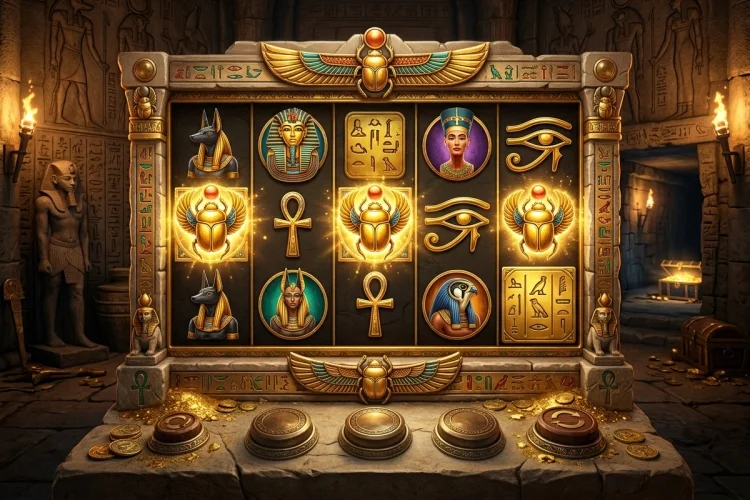
Ancient Egypt has almost everything a slot designer could want: famous rulers, powerful gods, mysterious writing, monumental architecture, and stories about life after death.
The setting is instantly recognizable even when the game uses fictional explorers or exaggerated magic. The strongest Ancient Egypt Slots do more than place pyramids behind ordinary reels.
They connect symbols with mechanics, turning scarabs into bonus triggers, ankhs into wilds, and tombs into feature chambers. Other games mainly use Egyptian artwork as decoration.
Knowing the difference can help you judge whether a title offers a thoughtful theme or simply repeats familiar visual clichés.
Historical Symbols Provide a Visual Shortcut
Real Egyptian symbols communicate ideas before the rules are explained. The ankh represented life, while the healed Eye of Horus was associated with protection, health, and regeneration. Scarabs also carried ideas connected with renewal and rebirth.
Developers translate those meanings loosely. An ankh may provide extra spins, an eye can upgrade symbols, and a scarab might unlock a bonus.
These functions are creative interpretations rather than strict historical rules, but they give the mechanics a recognizable visual identity.
Gods Create Natural Feature Characters
Egyptian gods frequently appear as high-paying symbols or special characters. Their supernatural roles make expanding wilds, multipliers, symbol transformations, and random modifiers feel appropriate.
Eye of Atum uses its creator god as an expanding wild and links its free-spin progression with symbol upgrades. Sisters of the Sun uses Egyptian goddesses and an Eye of Ra mechanic that increases its win multiplier.
A feature feels more connected to the theme when the character’s visual action explains what is happening on the reels.
Books and Tombs Support Adventure Stories
A mysterious book can serve as both a wild and scatter, while a tomb can act as the entrance to a free-spin feature. These objects let developers frame ordinary bonus activation as a discovery.
Book of Dead sends the fictional explorer Rich Wilde into an Egyptian tomb and uses its book symbol to unlock free spins. The bonus then selects a special expanding symbol.
Scroll of Dead changes the structure by adding a locked sixth reel that requires a scarab key. This gives the base game a visible objective beyond matching symbols.
Classic Layouts Remain Common
Many Egyptian games use five reels, three rows, and ten or twenty paylines. This structure is easy to understand and leaves plenty of space for recognizable characters and artifacts.
Pragmatic Play’s Ancient Egypt Classic uses a 3×5 layout with ten paylines and symbols including the ankh, Anubis, Cleopatra, the Eye of Ra, and a scarab beetle.
Traditional layouts work well for expanding-symbol features because a single icon can cover a complete reel and form several payline wins at once.
Modern Games Use Bigger Grids
Newer titles may use clusters, cascades, Megaways, or expanding grids while keeping the familiar Egyptian theme.
Mummy Megaways uses six reels, up to seven rows, changing win ways, Avalanche cascades, wild variations, and feature bars. Its official specifications list up to 117,649 ways to win.
Rich Wilde and the Tome of Dead also reimagines the Book of Dead concept on a dynamic 5×5 cascading grid.
These releases show that Egyptian games are no longer limited to traditional paylines.
Historical Accuracy Varies
Slot artwork often combines images from different Egyptian periods or places gods and rulers together even when they were not historically connected. Temples may also look more like movie sets than archaeological sites.
That does not automatically make the game poorly designed. Slots are entertainment products rather than museum exhibitions.
A useful review can still mention whether the symbols are inspired by authentic history, loosely adapted, or completely fictional. This helps readers separate cultural references from creative storytelling.
How to Compare Egyptian-Themed Games
Begin with the winning system, not the artwork. Identify whether the game uses fixed paylines, pays-anywhere combinations, clusters, or variable win ways.
Then check the wild, scatter, free-spin trigger, RTP, volatility, and maximum win. Compare how well the feature explanations match what happens on screen.
Finally, test the mobile layout. Detailed hieroglyphics and royal portraits may look attractive on a large monitor but become difficult to distinguish on a small phone.
Ancient Egypt Slots combine genuine cultural symbols with fictional adventure and modern game design.
Ankhs, protective eyes, scarabs, gods, and tombs provide a recognizable visual language, while paylines, wilds, expanding symbols, cascades, and jackpots determine the actual experience.
The best titles connect those two layers clearly. A scarab should feel like more than decoration, and a bonus should be understandable without repeated guessing.
Compare several demos, read the exact paytable, and judge how effectively each game turns its Egyptian theme into readable and engaging mechanics. Do not assume that familiar imagery means familiar rules.