
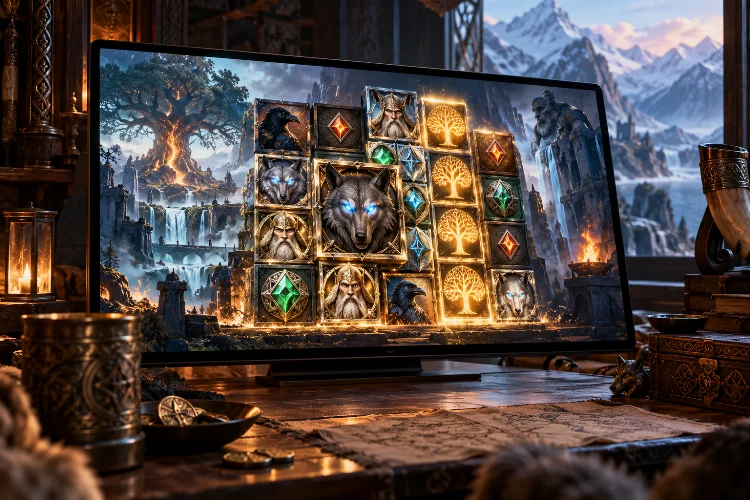
Some slot providers build almost everything around one successful formula. Yggdrasil takes a broader approach.
Its catalogue ranges from traditional paylines and progressive jackpots to expanding grids, giant symbols, reel multipliers, collection systems, and mechanics that can completely change the playing area.
That variety makes Yggdrasil Gaming Slots interesting to explore beyond their artwork.
Titles such as Vikings Go Berzerk and Valley of the Gods established recognizable gameplay ideas, while newer mechanics such as GigaBlox and MultiMAX push games toward more dynamic formats. Here are several important titles and the systems behind them.
Vikings Go Berzerk Made Character Progress Matter
Vikings Go Berzerk is one of Yggdrasil’s best-known earlier titles.
The 5×4 game uses 25 paylines, but its standout feature is the Rage Meter system. Wins involving one of the four Viking characters increase that Viking’s personal meter. Once full, the game enters Free Spins with that Viking in Berzerk Mode.
During the feature, the character can become a sticky Wild after defeating the Siren. A special Ragnarök version can even place all four Vikings into Berzerk Mode. Yggdrasil currently lists the title at 96.1% RTP with medium-to-high volatility.
The idea remains effective because it gives ordinary base-game wins a second purpose.
Instead of every spin existing seperately, character progress can build toward a feature.
Valley of the Gods Uses an Expanding Play Area
Valley of the Gods demonstrates another design idea strongly associated with Yggdrasil: letting successful spins physically change the game.
Every win creates a respin and helps remove blocker stones. As more blockers disappear, the playable area expands and the number of potential winning combinations increases.
The game can eventually reach 3,125 ways to win. Clearing the full area can introduce Lives and win multipliers, making longer chains increasingly valuable. Yggdrasil lists the game at 96.2% RTP and high volatility.
The sequel pushes this further.
Valley of the Gods 2 begins with 240 ways but can expand to 20,160. Removing all blockers unlocks special mechanics including Lives, multipliers, and a Wild Reel.
This progression makes the grid itself feel like part of the bonus system.
Holmes & the Stolen Stones Takes a Jackpot-Focused Route
Not every Yggdrasil title is built around massive multipliers.
Holmes & the Stolen Stones uses five reels, 20 paylines, a collection feature, and five local progressive jackpots. Its jackpot gameplay revolves around collecting colored diamond stones during special Free Spins.
Yggdrasil classifies it as low volatility with 96.8% RTP.
That makes it an interesting contrast to many newer feature-heavy games.
Instead of relying on huge multiplier chains, the game emphasizes collection progress and relatively frequent jackpot opportunities within its mathematical structure.
It is also a reminder that Yggdrasil Gaming Slots cover several risk profiles rather than following one standard volatility model.
GigaBlox Makes Symbols Physically Larger
GigaBlox is one of the most visually obvious mechanics in Yggdrasil’s wider portfolio.
The idea is simple: ordinary reel symbols can appear as much larger blocks occupying several positions at once.
In Primal Hunter GigaBlox, for example, giant symbols can reach 4×4 in size. Winning GigaBlox symbols explode and make room for new symbols, creating cascade opportunities. Free Spins introduce a multiplier that rises with each cascade.
Dragon Blox GigaBlox combines the mechanic with Lock’n Blox, a Monster Jackpot feature, and Monster Free Spins. Yggdrasil lists the game as high volatility with a maximum multiplier of 10,000x.
GigaBlox works because its effect is instantly visible.
A giant symbol covering sixteen positions communicates its importance more clearly than a hidden mathematical modifier.
MultiMAX Turns Reels Into Multiplier Engines
MultiMAX works differently.
Instead of enlarging symbols, it builds multipliers directly on individual reels.
Multifly! MultiMAX uses 243 ways and Dropdown wins. When a winning sequence occurs, a Wild can be added to a winning position. Those Wilds increase reel multipliers, which then apply to qualifying combinations passing through the relevant reel.
This creates a compounding style of gameplay.
One Dropdown win can produce a Wild, the Wild increases a reel multiplier, and another successful combination can then benefit from that stronger reel.
Yggdrasil revived the concept in MultiFly! 2 MultiMax, where every Avalanche win can generate Wilds that increase reel multipliers by varying amounts. The multipliers stack additively and affect wins crossing those reels.
The mechanic can look busy, but its central rule is suprisingly easy: stronger reels create stronger qualifying wins.
Splitz Turns One Symbol Into a Stack
Splitz is another mechanic built around changing the physical symbol layout.
Temple Stacks was Yggdrasil’s first Splitz title. Splitz can appear on any reel and reveal between three and nine identical symbols inside a mystery stack.
That can dramatically increase the number of matching symbols visible at once.
The title also lets Scatters lock into position for respins, while additional Scatters open different levels of Free Spins.
The important distinction from GigaBlox is that Splitz is not simply one oversized symbol.
Instead, the mechanic generates multiple same-symbol positions from a mystery stack.
Both systems increase symbol density, but they do it through different visual and mathematical ideas.
Yggdrasil Now Organizes Games Around Branded Mechanics
The current Yggdrasil catalogue highlights several named systems.
Its official game filters include GigaBlox, MultiMAX, Splitz, GigaRise, DoubleMax, Wild Fight, DuoMax, FastPot5, WildEnergy, TopHit, RushingWilds, BoltLock, OnlyWins, LightningLines, and Lock ’em & Load ’em.
This is important because modern Yggdrasil games are increasingly easy to group by mechanic rather than theme alone.
A player who enjoys multiplier progression can look for MultiMAX titles. Someone who likes giant symbols may gravitate toward GigaBlox.
That structure also helps sequels and partner-developed games maintain familiar mechanic identities even when artwork and themes change completely.
RTP and Volatility Still Need to Be Checked Separately
A branded mechanic does not tell you how volatile a game will be.
Holmes & the Stolen Stones is listed as low volatility, Vikings Go Berzerk sits at medium-high, and titles such as Dragon Blox GigaBlox are high volatility.
RTP can also vary by game and, in many modern titles, by available configuration.
Therefore, never assume GigaBlox, MultiMAX, or another feature automatically implies a specific return percentage or payout pattern.
Mechanics describe how a game produces action.
RTP and volatility describe different parts of its mathematical profile.
Check all of them seperatly when comparing titles.
Yggdrasil Gaming Slots cover everything from character-based classics such as Vikings Go Berzerk to expanding-grid games, progressive jackpots, GigaBlox symbols, and MultiMAX multipliers.
The studio’s wider portfolio stands out because mechanics often transform the reels rather than simply adding another bonus icon.
Explore a few different systems, read the feature rules, and compare RTP and volatility before deciding which style suits you best.