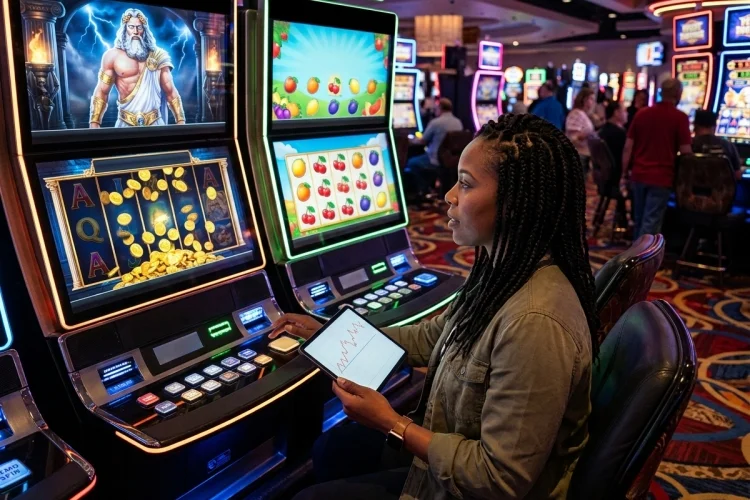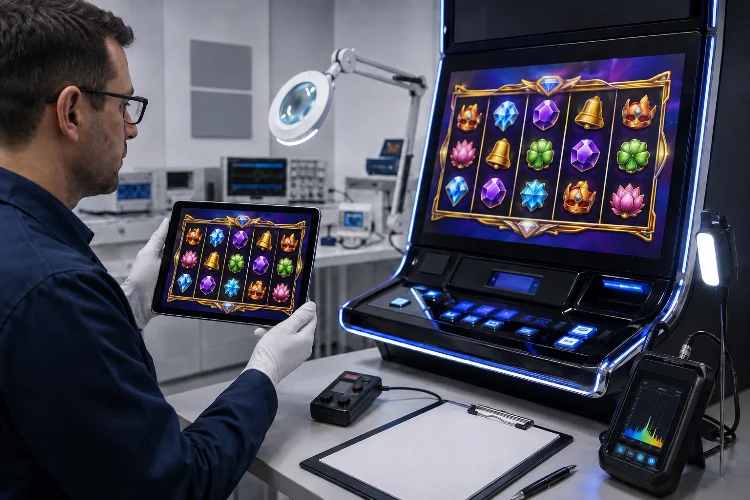
A free slot can look almost identical to its real-money version. The reels use the same artwork, bonuses appear familiar, and a virtual balance rises and falls without any real cash changing hands. The interesting question is whether the mathematics underneath is also the same.
In regulated environments, Free Slot Modes are not supposed to become artificially generous demonstrations designed simply to make the paid version look attractive.
In Great Britain, for example, the Gambling Commission requires play-for-free games offered alongside real-money equivalents to use the same game rules and accurately represent the likelihood of winning and prize distribution.
That means a genuine demo can provide a useful view of a game’s mechanics. It still cannot predict what will happen when real money is involved.
Free Play Should Replicate the Core Game Rules
The first layer of replication is straightforward: the game itself should behave like the corresponding paid version.
The UK Gambling Commission defines play-for-free as a demonstration version of a real-money game where the customer does not stake or win money or money’s worth.
If a slot has five reels, 20 paylines, expanding wilds, and a ten-spin bonus in real-money mode, the corresponding demonstration should not quietly use easier qualification rules or stronger prizes simply because the credits are virtual.
The important word here is corresponding.
If a provider offers several legitimate mathematical configurations of one title, the demo needs to represent the particular game offered alongside it rather than an unrelated, more generous configuration.
RTP Is Part of the Mathematical Framework
Return to player is one of the most important pieces of slot mathematics.
GLI defines RTP as the expected percentage of wagers that a specific game returns to players over the long run. The figure can be established mathematically or through simulation, depending on the game structure.
Suppose a slot has a theoretical RTP of 96%.
That does not mean every 100 demo credits will produce 96 credits back. RTP emerges only across a very large number of game rounds, while individual sessions can vary substantially.
The Gambling Commission similarly explains that RTP is a long-run average and that results during normal sessions vary because of game volatility.
So even when Free Slot Modes use the correct underlying RTP, a short demo session may look dramatically better—or worse—than the theoretical percentage.
The RNG Should Not Become Friendlier in Demo Mode
For random slots, the RNG is responsible for generating the values that eventually determine outcomes.
GLI describes RNG testing as a core element of iGaming certification, checking that outcome generation is non-predictable and does not contain unwanted bias.
For a demo to represent paid play accurately, its resulting game behaviour should reflect the same mathematical probabilities.
That does not mean a demo and real-money version will generate the same sequence of outcomes. They should not.
If two independent random sessions start at the same time, they can develop very differently while still following the same probablity model.
A demo might trigger free spins after 20 rounds while the real-money session might go hundreds of rounds without them. Randomness allows both experiences.
Parity means comparable rules and distribution, not identical sequences.
Paytables and Symbol Weighting Need to Work Together
Matching graphics alone would be meaningless if the underlying symbol probabilities were changed.
Imagine the real-money version pays 20× for five premium symbols. The demo also displays 20× in its paytable, but premium symbols are secretly generated twice as frequently.
The visible rules would appear identical while the actual experience would be mathematically different.
That is precisely why regulatory standards focus on representing not only the rules but also likelihood of winning and prize distribution.
A proper mathematical replica therefore involves more than copying payout values.
The relationship between symbol frequency, wild substitution, scatter frequency, prize size, and feature probability needs to produce the intended overall distribution.
Same Paytable Does Not Automatically Prove Same Mathematics
Players generally cannot reverse-engineer symbol weights from a few hundred spins.
A paytable tells you what outcomes pay, but not necessarily how frequently every outcome occurs.
That makes certification and operator responsibility important.
GLI’s interactive gaming standard states that free-play games should accurately represent the normal operation of paid games and should not mislead players.
Bonus Features Must Preserve Their Real Mathematical Behaviour
Modern slots often place a substantial amount of their expected value inside bonuses.
Free spins may introduce enhanced wilds, multipliers, different reel strips, retriggers, or changing symbol behaviour.
If a demo made those features trigger more frequently, it could create a misleading impression even if the base-game reels looked identical.
Likewise, increasing bonus multipliers only during free play would alter the prize distribution.
The full mathematical model therefore needs to include the seperate bonus states as well as ordinary spins.
Imagine a feature that triggers on average only rarely but can generate a large portion of the game’s highest prizes. Artificially increasing that trigger frequency would substantially change the player’s impression of volatility.
Correct replication requires the boring stretches as well as the exciting ones.
Volatility Should Feel Uneven in Both Modes
This is where demo play can confuse people.
If a slot is highly volatile, a legitimate free version should still be capable of producing long losing sequences, occasional clusters of wins, and rare large outcomes.
It should not smooth everything out just because the balance is virtual.
A game with high volatility may take a very large number of cycles before observed results resemble theoretical RTP. The Gambling Commission notes that fully random games can require extremely large samples for observed returns to approach their target level.
This means one 15-minute demo session tells you very little about long-run return.
The experience might be useful for understanding how volatile a game feels, but it is too small a sample for measuring the model accurately.
Virtual Credits Change Psychology, Not Necessarily Mathematics
There is another important difference that exists outside the game engine.
People usually behave differently when credits have no monetary value.
A player may choose the maximum virtual stake, spin faster, ignore balance swings, or continue after losing most of the demo bankroll. Those decisions may be very different from how the same person behaves when real money is involved.
So even when Free Slot Modes replicate the actual mathematics perfectly, they do not replicate the financial experience.
The game model can remain consistant, while the player’s decision-making changes.
This is why demo play is best treated as a way to understand rules, interface behaviour, paytables, and feature structure—not as evidence that the same balance trajectory will occur with real money.
A Short Demo Cannot Verify the RTP
Suppose you begin with 10,000 virtual credits and finish with 12,000.
It would be incorrect to conclude that the game has a 120% RTP.
You have measured one small sample.
Random variation can push actual session returns far above or below the theoretical value. Live RTP monitoring exists precisely because meaningful evaluation requires substantial aggregated wagering and payout information. The Gambling Commission says such monitoring aims to ensure games operate fairly as designed and advertised.
The same limitation applies if a demo appears unusually harsh.
One poor session does not prove the free version is underpaying.
You would need a much larger dataset and proper statistical analysis before making that judgement.
Free Play Is Better for Structure Than Prediction
The most useful way to use a demo is to examine the mechanics.
Read the paytable. See what triggers free spins. Observe how wilds behave. Learn whether cascades continue until no new win appears. Check how multipliers progress and whether bonus rounds can retrigger.
Those elements tell you about game architecture.
Trying to use recent free-play results to forecast paid outcomes is far less useful.
Random games do not owe the player a particular result because a bonus has not appeared recently. The occurence of previous outcomes does not create a schedule for future wins.
A demo can reproduce the model without revealing what the next random result will be.
Free Slot Modes can closely replicate real-money mathematics when they preserve game rules, RTP structure, symbol probabilities, volatility, bonuses, and prize distribution. What they cannot reproduce is the financial pressure of risking actual money or predict future outcomes.
Use demo play to study game structure and mechanics, but judge long-run mathematics from certified rules and statistical information rather than a short virtual-credit session.